
Feeding Autos: Less Is More
Autos eat less than bottle charts suggest. A week-by-week autoflower feeding plan with strength targets and the mistakes that cost the most.
Autoflowers break the rules of most nutrient charts, and the reason is simple arithmetic. A photoperiod plant might grow for five months and reach two metres. An auto lives twelve weeks and finishes under a metre and a half. The smaller, faster plant eats less, and it burns out faster when you overdo it. Feed an auto like a photoperiod and you'll salt-burn it in bud; feed it like the bottle says and you'll wonder why your leaves claw. Here's the version that works.
The rule: a quarter to half strength
Nutrient manufacturers print charts for photoperiods at full production, so their recommended dose is too rich for most autos from day one. Start at a quarter to half of the label dose and increase only when the plant asks for it, which it will do plainly: steady growth with no leaf-tip burn means you have room to climb. Burnt, dark-green tips mean you've arrived. Autos respond to overfeeding far faster than photoperiods, and they recover from it slower, so every increase should be small and spaced a few days apart.
The week-by-week plan
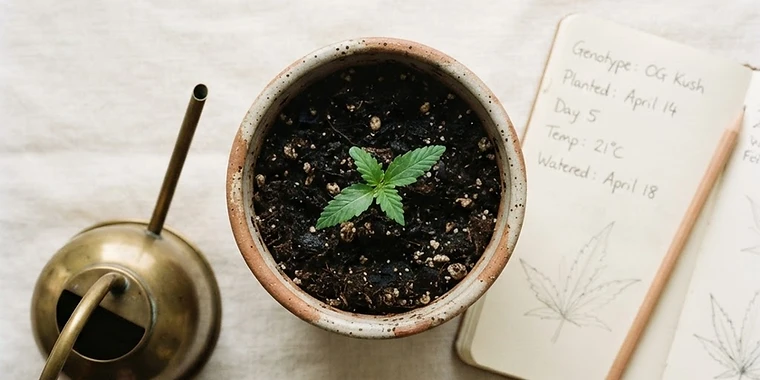
- Weeks 1 to 2, seedling. Plain pH-corrected water. A decent soil mix already contains weeks of nutrition, and a seedling's roots are too delicate for salts anyway. Resist the urge to feed; nothing here is hungry.
- Weeks 3 to 4, veg and pre-flower. Begin a light grow nutrient, the formula with the higher first number. If you grow under LEDs or use filtered water, add a splash of Cal-Mag now.
- Weeks 5 to 8, flower. Switch to the bloom formula, richer in phosphorus and potassium, and let nitrogen fall away. This is where feeding strength peaks, and it's where the quarter-to-half rule earns its keep.
- Final 7 to 10 days. Taper to plain water. The plant is finishing, not building, and old salts in the medium dull flavour more than they help weight.
Strength targets, if you measure
Coco and hydro growers steer by electrical conductivity, so here are the numbers that work for autos at the standard 700 scale: seedlings 200 to 400 ppm, veg 500 to 900, peak flower 1,000 to 1,500. Soil growers can work more loosely by feel, since the medium holds reserves, but the same ceiling applies: when in doubt, dilute. The pH and EC guide explains how to read runoff and catch build-up before the plant shows it.
Soil versus coco changes the picture
In soil, the mix is part of the meal. Compost and castings carry nitrogen, and a well-amended pot may need nothing beyond water until week four or five. In coco, the medium is inert: every element the plant eats arrives through your water, from the first week of veg onward. Coco autos therefore get fed from earlier and more often, while soil autos get fed later and lighter. Neither is superior; they just speak different languages, which is why the synthetic versus organic guide matters more than any brand comparison.
Read the plant, not the calendar
The feeding chart is a starting point. The plant is the instrument. Dark, clawing leaves pointing down mean too much nitrogen, and the fix is to skip a feed entirely. Pale lower leaves yellowing evenly upward mean the tank is running low on nitrogen, most common in coco and in soil grows past week five. Rusty or brown spots on otherwise healthy leaves usually trace to calcium or magnesium, and nine times out of ten the underlying cause is pH drift rather than a missing element, so check the root zone before you add anything. The leaf-by-leaf deficiency guide walks through every pattern in detail.
The three mistakes that cost the most
First, full-strength feeding from week two, which stunts more autos than every pest combined. Second, feeding a dry pot, which delivers a concentrated salt hit to the roots; water lightly before you feed heavily. Third, continuing bloom nutrients into the final week and then wondering why the smoke is harsh. Autos forgive a lot, but they punish impatience, because their entire life is too short for a bad week to even out.
Feed light, watch the leaves, and give the plant plain water when its behaviour says it's had enough. That's the whole method, and it produces better autos than most complicated schedules ever will.