
pH and EC: The Hidden Half of Feeding
The root zone decides what plants can absorb. pH ranges, EC targets, runoff readings and the flush that fixes lockout, in a two-minute habit.
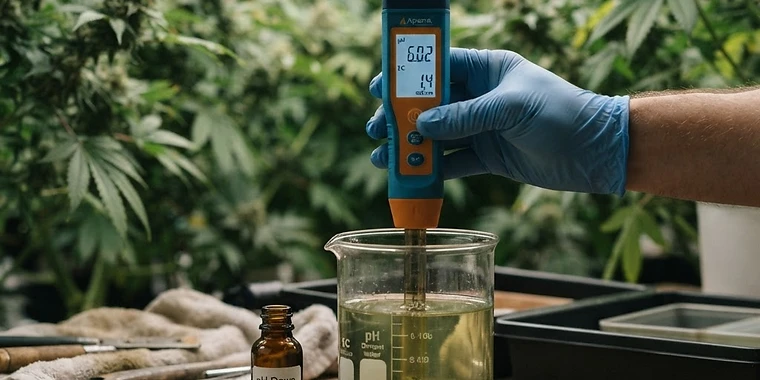
Here's a pattern every grower eventually meets. A plant shows deficiency symptoms, the grower reaches for more nutrient, and the plant gets worse. The bottle wasn't empty. The root zone was locked. Feeding is only half the job, and availability is the other half, which is written in two numbers worth more than any supplement you'll ever buy: pH and EC. This guide turns both into a five-minute habit.
pH: the doorman at the root
Every nutrient dissolves into a form roots can absorb only inside a pH window. Outside it, the element is still sitting in the medium, perfectly present and chemically invisible. Growers call this lockout, and it's the most common misdiagnosis in the hobby: an iron or calcium shortage caused not by missing elements but by a root zone that drifted out of range. Before you add anything to a symptomatic plant, this is the number to check.
Soil grows run 6.0 to 7.0, and the organic matter in a decent mix buffers a fairly wide band. Coco and hydro run tighter, 5.5 to 6.5, because there's no buffer and precision pays. Park in the middle, around 6.2 in soil and 6.0 in inert media, and nearly everything is available at once. Ignore the forum advice about cycling pH high and low to feed different elements at different times. That's folklore, and the truth is more boring: a stable mid-range reading beats a cycling one in every trial anyone has published.
The habit is two tests per feed. First the input: test your water after mixing nutrients, because nutrients move pH, then adjust with a few drops of pH down or up. Second the runoff: the water draining from the pot's bottom tells you what the root zone actually is, not what you hoped it was. If your input sits at 6.3 and your runoff creeps toward 7.5, the medium is drifting alkaline. Correct gradually over several waterings, never in one heroic swing, because roots tolerate a steady drift far better than a sudden reversal.
A modest digital pen beats the liquid drop kits for speed and repeatability, and one calibration bottle keeps it honest for years.
EC: the strength gauge
Electrical conductivity measures the total dissolved salts in your water. It can't tell you which nutrients are present, only how much of everything, and that turns out to be exactly what you need to avoid the two classic failures: starving a hungry plant and burning a sensitive one.
Typical bands for autos on the 700 scale run like this: seedlings 200 to 400 ppm, veg 500 to 900, early flower 900 to 1,300, peak flower 1,100 to 1,600. Coco and hydro growers live inside these numbers because in an inert medium the reservoir is the entire diet. Soil growers can work by feel, since the medium holds its own reserves, but the meter still answers the question your plant would otherwise answer too late: is my feeding getting stronger, or is my soil running out?
The comparison that does the real work is input against runoff. Feed at 1.5 and find runoff at 2.2, and salts are accumulating, so you should water to more runoff or drop your strength. Feed at 1.5 and find runoff at 0.9, and the medium is eating everything you give, which means the plant is hungry and you can push. That single contrast converts feeding from a guess into a conversation. The feeding guide lists the stage-by-stage targets in full.
Flushing, the reset button
When salts pile up, burned tips everywhere, runoff EC far above input, deficiency symptoms that resist feeding, a gentle flush resets the root zone. Pour through two to three times the pot's volume of pH-corrected water, let it drain fully, then resume feeding at roughly half your previous strength. Flush early in a problem rather than as a last resort. A lockout corrected in two days costs nothing; corrected in two weeks, it costs yield.
The separate tradition of flushing for the final week, plain water only to improve taste, divides growers and always has. What isn't disputed is that the final watering should be plain, pH-corrected water with nothing added, and jars from those plants never taste worse for it.
The starter kit
You need three tools: a pH pen, an EC meter, many of which come combined, and adjustment solution. The routine is two minutes per feed. Mix nutrients, then pH the mix. Aim mid-band. Log input and runoff for both meters, a note on your phone being entirely sufficient. Within a week you'll know your water's personality, and within a month you'll catch drift before a single leaf turns. The best growers aren't the ones feeding the most. They're the ones keeping the root zone boring, stable, and in range, which is also what makes symptoms rare enough that the deficiency guide becomes light reading.