
Spotting Nutrient Deficiencies Early: A Leaf-by-Leaf Guide
Learn to read yellowing, spotting, and purple stems — what each common deficiency looks like and how to fix it before it costs yield.
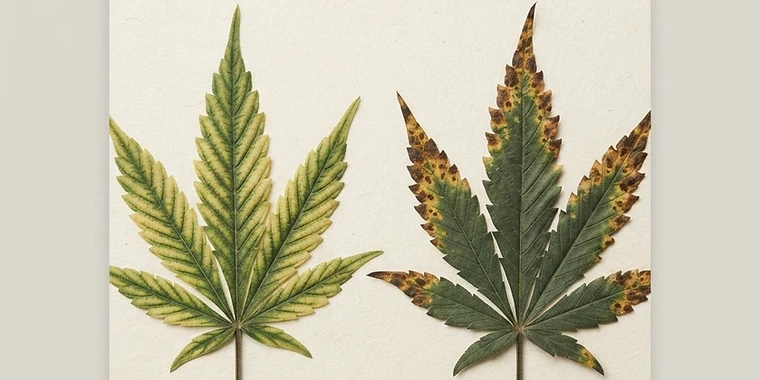
Yellow leaves, rusty spots, and purple stems tell a story — the trick is reading them before they cost you yield. This guide walks through the most common deficiencies in autoflowers, what each one looks like, and how to fix it fast.
Start With pH, Not Fertilizer
Before you add a single nutrient, check your runoff pH. In soil, roots absorb nutrients best between 6.0 and 7.0; in coco and hydro, aim for 5.5 to 6.5. If pH drifts out of range, nutrients lock out — the plant starves even in perfectly fertilized medium. A "deficiency" that won't respond to feeding is almost always a pH problem in disguise.
Nitrogen (N) — The Yellow Start
- Where it shows: oldest (lowest) leaves first, yellowing evenly from the tips inward.
- Why: nitrogen is mobile; the plant robs old growth to feed new growth.
- Fix: a balanced grow fertilizer or a gentle topdress of blood meal. Don't panic at slight yellowing in the final 2–3 weeks — that's normal ripening, not deficiency.
Phosphorus (P) — Purple Stems and Dark Leaves
- Where it shows: lower leaves darken to blue-green, then develop purple or bronze patches; stems may streak purple.
- Fix: bloom fertilizer with a higher P number, or a mild bat guano tea. Cold root zones (below 18°C) also block phosphorus — warm the medium before overdosing.
Potassium (K) — Rusty Edges
- Where it shows: burnt, rusty-brown edges and tips on older leaves, sometimes with yellowing between the veins.
- Fix: a K-rich bloom booster, wood ash in tiny amounts (it raises pH), or a potassium sulfate topdress.
Calcium (Ca) — Twisted New Growth
- Where it shows: new leaves emerge crumpled, hooked, or with brown irregular spots; commonly seen in coco and LED grows.
- Fix: Cal-Mag supplement at label rate, or garden lime mixed into soil at the start. Soft, filtered water often lacks calcium.
Magnesium (Mg) — Yellow Between the Veins
- Where it shows: interveinal chlorosis on middle and lower leaves — the veins stay green while the rest yellows, sometimes with shiny rust flecks.
- Fix: a foliar spray of Epsom salts (1 tsp per litre) for a fast response, plus a Cal-Mag supplement in the feed. LED-heavy grows demand more Mg than you'd expect.
Micronutrients — Rare but Real
- Iron: identical look to magnesium, but on the newest growth first.
- Zinc: narrow, distorted new leaves with yellow banding.
- Boron: thick, brittle, cracked new growth.
These almost never appear except in coco, RO-water-only grows, or overwatered pots.
Toxicity Counts Too
Clawing dark-green leaves usually mean too much nitrogen — ease off, not up. Crispy burnt tips across the whole plant point to nutrient burn from overfeeding: flush gently with pH-correct water and resume at half strength.
The Recovery Playbook
- Confirm pH and EC of your runoff.
- Identify the pattern: old growth (mobile N, P, K, Mg), new growth (immobile Ca, Fe, Zn).
- Fix at half strength and wait 3–4 days — deficiencies improve slowly.
- Remove only leaves that are more than 50% damaged; a leaf can still feed the plant.
Autoflowers move fast, so a small, early correction beats a big, late one. Check your plants under bright light for five minutes every morning and you'll catch almost everything at the first sign.