
Synthetic vs Organic: Choosing How to Feed
Mineral salts or microbe-fed meals? How each feeding philosophy works, where each one wins, and how to choose for your medium and schedule.
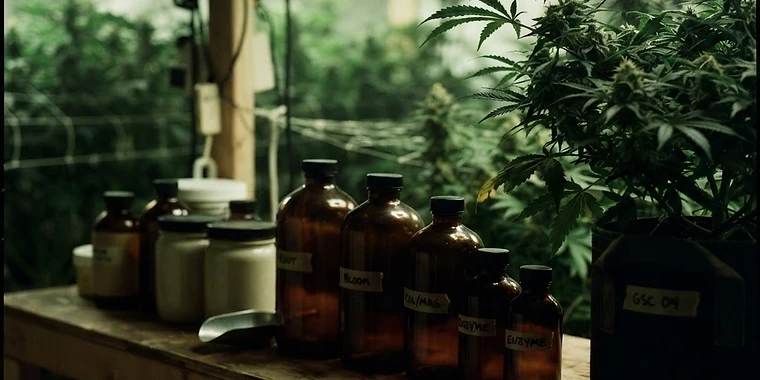
Walk down the nutrient aisle — physical or virtual — and you'll find yourself at a fork: bottles promising laboratory-pure mineral salts on one side, dark organic teas and dry amendments on the other. Both camps grow excellent cannabis. Both camps also have ways to make your grow worse. This guide lays out how each approach actually works, where each shines, and how to choose for your medium, schedule, and temperament — because the best nutrient system is the one you'll run consistently.
How Synthetic Nutrients Work
Synthetic (mineral, or 'salt') nutrients deliver plant-available ions directly: nitrate, phosphate, potassium sulfate. Dissolve them in water and the root hairs absorb them almost immediately, with the plant's uptake governed mainly by pH and concentration.
Strengths:
- Precision. You can read EC, hit an exact ppm, and correct it tomorrow. Feeding is engineering, not alchemy.
- Speed. Corrections show within days — the reason salt feeding dominates coco and hydro, where there's no soil buffer to forgive a mistake.
- Clean automation. Reservoirs stay predictable, lines stay clearer than with organic teas, and dosing is repeatable.
Weaknesses: feed the plant, not the medium — there's no biology building structure, salts accumulate (hence runoff watering and periodic flushing), and precise systems punish imprecision. Hydroponics without EC and pH discipline is a fast way to lose a plant.
How Organic Nutrients Work
Organic inputs — compost, worm castings, kelp and alfalfa meals, guanos, fish hydrolysate, molasses — aren't plant food in the direct sense. Microbes decompose them into available ions on a biological timetable. You're managing an ecosystem's grocery deliveries, and the ecosystem manages the plant.
Strengths:
- Buffering. The soil food web releases nutrients on demand and self-regulates pH; overfeeding is nearly impossible and underfeeding is slow to bite. Beginners get forgiveness baked in.
- Flavour reputation. Terpene expression in well-built living soil is the perennial fixation of competition growers.
- Simplicity at scale. A cooked super soil can carry an autoflower from seed to harvest on water alone.
Weaknesses: slow and imprecise. A visible deficiency takes days to correct through a microbial pipeline, root zones stay cooler and wetter-loving, teas can sour, and organic nutrient content varies batch to batch. There's also no honest EC number to steer by.
The Hybrid Reality — and What the Pros Actually Do
The fork is softer than marketing suggests. Many successful growers run a mineral base in coco with an organic topdress and a compost tea here and there; many soil growers keep a bottle of Cal-Mag (a mineral salt) on the shelf for LED-season emergencies. The honest categories are less 'organic vs synthetic' than 'how much buffer do you want':
- Hydro or coco with runoff feeding → mineral base, full pH/EC discipline. Biology has nowhere to live in a reservoir; precision is your friend.
- Container soil, auto-pots, or hand-watered pots → either works. Mineral gives control and speed; organics give resilience and a lighter schedule. Autos pair beautifully with the organic route, since they hate interruptions and a cooked soil never asks for one.
- Living soil / no-till → organics, essentially by definition — you're investing in the web, not the plant, this cycle.
Three Buying Rules That Hold in Both Camps
- Buy complete before you buy clever. A solid two- or three-part base plus a Cal-Mag covers a whole grow; everything else is a garnish.
- Match the line to your medium. Lines formulated for soil run gentler; hydro lines assume you're steering by EC. Mixing philosophies carelessly is how growers double-feed.
- Ignore the bottle's chart at full strength. Start at a quarter to half dose — autoflowers especially — and climb. Underfed plants recover in a week; overfed ones cost you yield.
The Honest Verdict
There is no chemically magical difference between a nitrate ion from a bottle and one released by a microbe — the plant reads the same element either way. What differs is the system around it: precision versus buffer, speed versus forgiveness. Choose the philosophy that fits your medium and your schedule, learn to read its signals — EC and pH for salts, plant and soil cues for biology — and stay consistent. Consistency, in either camp, outperforms purity every time.